
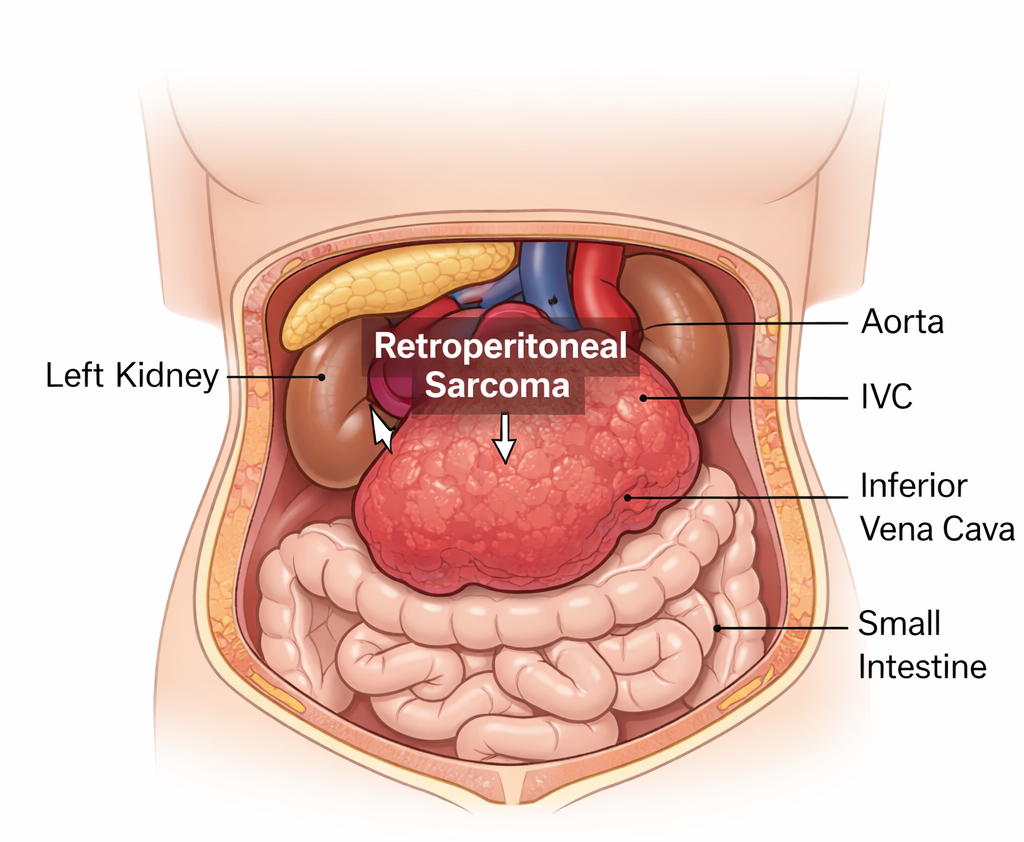
Retroperitoneal sarcoma in a postmenopausal woman: case report and literature review
DOI:
https://doi.org/10.19230/jonnpr.6021Keywords:
retroperitoneal sarcoma, gynecologic oncology, differential diagnosis, clinical case, differential diagnosisAbstract
Introduction: Retroperitoneal sarcomas constitute a rare and aggressive group of mesenchymal neoplasms. Due to their deep anatomical location, they pose significant diagnostic and therapeutic challenges. Their nonspecific symptomatology may lead to misdiagnosis; in fact, in this case, the tumor was initially identified as a uterine sarcoma.
Objective: To describe the clinical, diagnostic, and therapeutic course of a case of retroperitoneal sarcoma initially diagnosed as uterine sarcoma. Materials and methods: A descriptive, retrospective clinical case study was conducted through a chronological analysis of the clinical evolution of a patient over 50 years of age, diagnosed and treated between 2019 and 2024 in secondary- and tertiary-level institutions in Mexico. Previous results: The patient underwent multiple surgical procedures and received radiotherapy following local recurrences. Imaging studies, such as PET-CT and computed tomography scans, confirmed the retroperitoneal location. Comprehensive evaluation allowed reclassification of the neoplasm and achievement of sustained clinical control, with no tumor activity detected on recent follow-up. Conclusion: This case highlights the importance of a multidisciplinary approach and differential diagnosis in complex pelvic masses. Although the outcome was negative with respect to the initial diagnosis, it provides relevant clinical evidence for the recognition and appropriate management of retroperitoneal sarcomas and contributes to oncological knowledge from a Latin American context.
Downloads
References
1. Abeler, V. M., Royne, O., Thoresen, S., Danielsen, H. E., Nesland, J. M., & Kristensen, G. B. (2009). Uterine sarcomas in Norway: A histopathological and prognostic survey of a total population from 1970 to 2000 including 419 patients. Histopathology, 54(3), 355–364.
2. Amant, F., Coosemans, A., Debiec-Rychter, M., Timmerman, D., & Vergote, I. (2018). Clinical management of uterine sarcomas. The Lancet Oncology, 19(3), e149–e161.
3. Brooks, S. E., Zhan, M., Cote, T., & Baquet, C. R. (2004). Surveillance, epidemiology, and end results analysis of 2677 cases of uterine sarcoma. Gynecologic Oncology, 93(1), 204–208.
4. D'Angelo, E., & Prat, J. (2010). Uterine sarcomas: a review. Gynecologic Oncology, 116(1), 131–139.
5. Fierro-Maya, F., Quiroga-García, A., & Mora-Castaño, J. (2015). Leiomiosarcoma uterino: reporte de caso y revisión de la literatura. Revista Colombiana de Obstetricia y Ginecología, 66(3), 205–212.
6. Gockley, A. A., Melamed, A., Bregar, A. J., Clemmer, J. T., Schorge, J. O., & del Carmen, M. G. (2017). Management patterns of uterine sarcoma: A National Cancer Database analysis. Gynecologic Oncology, 145(1), 61–70.
7. Gómez-Cano, M., Restrepo-Cadavid, E., & Uribe-Tirado, J. (2023). Caracterización clínica y molecular de sarcomas uterinos en un hospital universitario en Colombia. Revista Colombiana de Obstetricia y Ginecología, 74(2), 110–120.
8. Griffin, N., Charles-Edwards, G., & Khan, A. (2016). Retroperitoneales sarcomas: review of the imaging features and management of primary and recurrent disease. Clinical Radiology, 70(6), 574–588.
9. Instituto Nacional de Cancerología. (2023). Boletín epidemiológico: Cáncer ginecológico. INCan.
10. Lira-Barragán, L. F., García-Espinoza, J. D., & Hernández-Sierra, M. (2022). Experiencia en el tratamiento del leiomiosarcoma uterino en un hospital mexicano de referencia. Ginecología y Obstetricia de México, 90(6), 321–329.
11. Organización Mundial de la Salud (WHO). (2020). Classification of Tumours: Female Genital Tumours (5th ed.). IARC.
12. Giannini, A., D'Augè, T. G., Bogani, G., Laganà, A. S., Chiantera, V., Vizza, E., ... & Di Donato, V. (2023). Uterine sarcomas: A critical review of the literature. Eur J Obstet Gynecol Reprod Biol., 287, 166-170.SEER Cancer Statistics Review, 1975–2019. National Cancer Institute.
13. Silva, I. D., De Brot, L., Baiocchi, G., Gebrim, L. H., Sun, S. Y., & Soares, F. A. (2021). Uterine sarcomas: clinicopathological analysis of 24 cases. São Paulo Medical Journal, 139(3), 1–8.
14. Tanaka, T., Terai, Y., Fujiwara, S., Ono, Y., & Ohmichi, M. (2018). Clinical analysis of retroperitoneal sarcoma misdiagnosed as gynecologic disease. Archives of Gynecology and Obstetrics, 297(5), 1229–1234.
15. Vijay, A., Bhosale, P., Szklaruk, J., & Iyer, R. (2022). Diagnostic accuracy and challenges in imaging of retroperitoneal tumors: What the radiologist needs to know. Abdominal Radiology, 47(1), 125–136.
Downloads
Published
Issue
Section
License
All accepted originals remain the property of JONNPR. In the event of publication, the authors exclusively transfer their rights of reproduction, distribution, translation and public communication (by any sound, audiovisual or electronic medium or format) of their work. To do so, the authors shall sign a letter transferring these rights when sending the paper via the online manuscript management system.
The articles published in the journal are freely used under the terms of the Creative Commons BY NC SA license, therefore.
You are free to:
Share — copy and redistribute the material in any medium or format
Adapt — remix, transform, and build upon the material
The licensor cannot revoke these freedoms as long as you follow the license terms.
Under the following terms:
Attribution — You must give appropriate credit, provide a link to the license, and indicate if changes were made. You may do so in any reasonable manner, but not in any way that suggests the licensor endorses you or your use.
NonCommercial — You may not use the material for commercial purposes.
ShareAlike — If you remix, transform, or build upon the material, you must distribute your contributions under the same license as the original.
No additional restrictions — You may not apply legal terms or technological measures that legally restrict others from doing anything the license permits.

This work is licensed under a Creative Commons Attribution-NonCommercial-ShareAlike 4.0 International License