Artículos
Exploring suicidal ideation in adolescents and young adults: eating disorders (ED), psychological distress, self-esteem and family satisfaction
Exploring suicidal ideation in adolescents and young adults: eating disorders (ED), psychological distress, self-esteem and family satisfaction
Ehquidad: La Revista Internacional de Políticas de Bienestar y Trabajo Social, núm. 26, pp. 149-186, 2026
Asociación Internacional de Ciencias Sociales y Trabajo Social

Esta obra está bajo una Licencia Creative Commons Atribución-NoComercial-CompartirIgual 4.0 Internacional.
Recepción: 12 Septiembre 2025
Revisado: 15 Febrero 2026
Preprint: 15 Mayo 2026
Aprobación: 01 Junio 2026
Publicación: 01 Julio 2026
Financiamiento
Fuente: Ministerio de Ciencia, Innovación y Universidades. Convocatoria Generación de Conocimiento 2023.
Nº de contrato: PID2023-147438OB-I00
Financiamiento
Fuente: Vicerrectorado de Investigación y Transferencia. II Plan Propio de Investigación, Transferencia y Divulgación Científica de la Universidad de Málaga
Nº de contrato: PPRO-HUM590-G-2023 (HUM590-G-FEDER).
Abstract: This study examines the effect of psychological factors (eating disorders (EDs), psychological distress, self-esteem, and family satisfaction) on suicidal ideation among adolescent and young adult students. Conducted in Cádiz and Málaga (Spain) with 494 participants aged 16–29, the study used standardized questionnaires to measure these variables. Results showed that eating disorders and psychological distress were positively associated with suicidal ideation, while self-esteem and family satisfaction were protective. Regression analysis explained 32.1% of the variability in suicidal ideation. Age, but not sex, moderated some associations, with stronger effects in younger participants. These findings highlight the importance of addressing these factors through educational interventions and research to prevent suicidal ideation in this population.
Keywords: Suicidal ideation, Eating disorders, Psychological distress, Self-esteem, Family satisfaction.
Resumen: Este estudio analiza el efecto de factores psicológicos (trastornos alimentarios (TCA), malestar psicológico, autoestima y satisfacción familiar) sobre la ideación suicida en estudiantes adolescentes y jóvenes adultos. Realizado en Cádiz y Málaga (España) con 494 participantes de entre 16 y 29 años, el estudio empleó cuestionarios estandarizados para medir estas variables. Los resultados mostraron que los trastornos alimentarios y el malestar psicológico se asociaban positivamente con la ideación suicida, mientras que la autoestima y la satisfacción familiar tenían un efecto protector. El análisis de regresión explicó el 32,1 % de la variabilidad en la ideación suicida. La edad, pero no el sexo, moderó algunas asociaciones, observándose efectos más intensos en los participantes más jóvenes. Estos hallazgos resaltan la importancia de abordar estos factores mediante intervenciones educativas e investigación para prevenir la ideación suicida en esta población.
Palabras clave: Ideación suicida, Trastornos de la conducta alimentaria, Malestar psicológico, Autoestima, Satisfacción familiar.
1. Introduction
The transition from adolescence to young adulthood is often associated with ideas of progress and the future. Ideally, being young should involve the development of interpersonal and social skills to help navigate the challenges and difficulties that arise with adulthood. However, recent global challenges, such as the COVID-19 pandemic, coupled with various economic and social crises that have impacted the world—and especially Spain—over the past few decades, alongside the country’s own structural problems, have significantly affected the well-being of young people and as expected, their opportunities and outlook for the future (Ballesteros, 2023).
Amid this backdrop of uncertainty and economic and social changes, suicide—and specifically, suicidal ideation—among adolescents and young adults in Spain has garnered increasing attention in recent years. Between 2019 and 2021, the number of adolescents and young adults experiencing frequent suicidal thoughts rose significantly, from 5.8% in 2019 to 8.9% in 2021 (Sanmartín et al., 2022). Moreover, suicide has become the leading cause of death among individuals aged 15 to 29 in Spain (Instituto Nacional de Estadística, 2021).
These alarming trends suggest that the transition from adolescence to adulthood, which is typically seen as a period of development and growth, is now overshadowed by significant risk factors. These include feelings of existential emptiness, depression, anxiety, hopelessness, economic difficulties, low self-esteem, excessive preoccupation with body image, substance abuse, family dysfunction, and traumatic experiences like bullying or sexual abuse.
Additional risk factors also include gender-based discrimination and social exclusion. Any of these factors, whether individually or in combination, can severely impact adolescents’ mental health and increase the risk of suicidal ideation (Kaloğlu & Hocaoglu, 2023; Serrano-Ruiz et al., 2017).
This study examines two critical risk factors: eating disorders (EDs) and psychological distress, which includes symptoms of anxiety and depression. Both factors are closely associated with suicidal ideation and can significantly increase emotional vulnerability in adolescents and young adults (Junus & Yip, 2023; Kaloğlu & Hocaoglu, 2023).
The study also examines two essential protective factors: self-esteem and family satisfaction. Self-esteem, as a measure of self-concept and self-worth, can serve as a buffer against suicidal ideation (Shagufta, 2022). Family satisfaction, reflecting emotional support and positive relations within the home, can provide a safe and nurturing environment for adolescents and young adults (Cuadris-Torres, 2023; Yang et al., 2022).
The aim of the study is to provide insights and relevant knowledge to prevent suicidal ideation and help develop effective intervention strategies by identifying some of the key factors associated with the prevention and development of these thoughts.
1.1. Suicidal ideation
The word “suicide” originates from the Latin terms sui, meaning ‘self’, and caedere, translated as ‘the act of slaying’. Suicide is a deliberate and voluntary act in which an individual chooses to end their own life. It is a complex issue that is often caused by a combination of personal, social, psychological, environmental and biological factors. Additionally, it typically results from an intense emotional struggle and a sense of despair or a lack of alternatives to cope with adverse situations (Barroso, 2019). On the other hand, suicidal behaviors include suicidal thoughts, plans, failed attempts and self-injuries that do not necessarily result in death but reflect a tendency or desire to end one’s life (Gvion & Apter, 2012).
In this context, the process leading to suicide can be understood as beginning with suicidal ideation, which indicates vulnerability and may, in some cases, progress to a suicide attempt and, if successful, to completed suicide (Cañón & Carmona, 2018).
To better understanding the process of suicidal ideation, it is important to distinguish between passive and active suicidal ideation. Passive suicidal ideation refers to thoughts or wishes to die that do not involve a specific plan or intention to commit suicide; instead, they reflect ambiguity about one’s own death. In contrast, active suicidal ideation is characterized by detailed thoughts regarding one’s death, often accompanied by a specific plan and method for committing suicide (Baños-Chaparro, 2024).
Suicidal ideation is a significant issue that affects the general population, but in recent years, it has shown a particularly high incidence among adolescents and young people. Recent studies indicate that 44.3% of individuals aged 15 to 29 have experienced suicidal ideation at least once in their lives (Sanmartín et al., 2022), highlighting the magnitude of the problem within this age group.
Additionally, while completed suicide is more common among men, women tend to experience suicidal ideation more frequently. This trend is particularly evident among adolescents and young adults (Cañón & Carmona, 2018; Spanish National Statistics Institute, 2022; Urdiales-Claros & Sánchez-Álvarez, 2021). Differences between the sexes may be influenced by various factors, including the methods of suicide; men are more likely to use violent and lethal methods compared to women (Fitzpatrick et al., 2022). Women also tend to receive stronger social support from friends, partners and relatives. Their coping strategies are generally more optimistic, and they are more likely than men to seek medical care, which facilitates early detection of mental health issues. In contrast, men often find it more challenging to acknowledge and seek help for mental health concerns, which can lead to an increase in suicidal behaviors (Cenkseven-Önder, 2018).
Research on suicidal ideation in adolescents and young adults shows that many individuals exhibit warning signs before making the tragic decision to attempt suicide. In fact, it is estimated that between 70% and 80% of those who attempt suicide give warnings or display clear signs beforehand. This highlights the importance of recognizing these signals, along with the associated risk factors, as key elements in suicide prevention (Fonseca-Pedrero & Díez, 2018). Recent research has highlighted several key risk factors associated with suicidal behaviors in young people. These include mental health disorders, previous suicide attempts, specific personality traits, genetic predisposition and family dynamics. These factors often combine with triggering psychosocial stressors, exposure to role models and access to means of committing suicide (Bilsen, 2018).
Many studies identify depression, anxiety, and other mental disorders as the main triggers of suicidal behaviors in adolescents and young adults (Leigh et al., 2022; Metts et al., 2023; Park, 2023), however, some researchers suggest that additional or combined risk factors extend beyond mental health issues. Factors such as economic circumstances, academic performance, social and family relationships, low self-esteem, experiences of sexual abuse or neglect, unemployment, violence and lack of opportunities also play a crucial role. Moreover, elements like the perception of social support, traumatic experiences, and pressure regarding future career prospects can significantly influence young people's propensity for suicidal behaviors (Cañón & Carmona, 2018).
1.2. Risk factors
Risk factors significantly influence suicidal ideation by increasing the likelihood that an individual will experience suicidal thoughts or act on them. These factors can be biological, psychological, social, or environmental in nature, and they often interact in complex ways, contributing to higher risks (Alves da Silva, et al., 2023; Karayazi, 2023). This section examines two key factors: eating disorders and psychological distress, including anxiety and depression, due to their strong impact on suicidal ideation among adolescents and young adults (Junus & Yip, 2023; Kaloğlu & Hocaoglu, 2023 Karayazı, 2023).
1.2.1. Eating disorders
According to Bermúdez et al. (2021), eating disorders (EDs) are a group of mental health disorders characterized by atypical behaviors related to food and weight control. These disorders often involve dissatisfaction with one’s own body, a persistent fear of gaining weight and obsessive thoughts about eating. The most well-known EDs are anorexia and bulimia nervosa, both classified in the Diagnostic and Statistical Manual of Mental Disorders, Fifth Edition (DSM-5). However, there has recently been an increase in the incidence of another disorder known as orthorexia nervosa (García-Puertas, 2020).
Scientific literature confirms that EDs more frequently affect adolescents and young adults, particularly women, though they can occur in individuals of any age and also in men. These two life stages are especially vulnerable due to the physical and emotional changes they entail, as well as the social pressures related to body image and the desire to meet certain standards, which are heavily influenced by social media (Arrija-Val et al., 2022; Franco et al., 2019; García-Puertas, 2020; González & Miguel, 2023).
Recent studies highlight that adolescents and young adults with eating disorders are at a higher risk of suicidal ideation and behaviors (Kaloğlu & Hocaoglu, 2023; Lipson & Sonneville, 2020; Perkins et al., 2021; Semenova et al., 2022 Smith et al., 2018; Wang et al., 2019). For example, some studies report that 30.6% of young people hospitalized for anorexia nervosa have experienced suicidal ideation, and 3.4% have made suicide attempts (Duriez et al., 2023). This relationship is driven by a combination of biological, psychological, and social factors that interact and impact both the physical and mental health of adolescents and young adults. First, EDs can disrupt the brain's balance of neurotransmitters like serotonin and dopamine, which are critical for regulating mood. These imbalances can make individuals more susceptible to depression and other emotional disorders, thereby increasing the risk of suicidal thoughts (Bermúdez et al., 2021; Kaloğlu & Hocaoglu, 2023).
At a psychological level, adolescents with eating disorders often struggle with low self-esteem and extreme perfectionism. This internal pressure can lead to feelings of hopelessness and excessive self-criticism, which can severely affect their mental health. Additionally, eating disorders frequently co-occur with other conditions like depression and anxiety, further increasing the risk of suicidal ideation (Bermúdez et al., 2021; Smith et al., 2018; Wang et al., 2019).
On the other hand, social factors involve intense pressure to conform to beauty standards and cultural expectations surrounding body image. This pressure is particularly strong among young people, often contributing to the development of suicidal ideation (García-Puertas, 2020; González & Miguel, 2023; Kaloğlu & Hocaoglu, 2023).
Additionally, certain behavioral aspects should be considered, as some eating disorders, particularly bulimia nervosa, are linked to impulsive and risky behaviors, such as substance abuse (Bermúdez et al., 2021). It is also common for individuals with eating disorders to engage in self-harm as a way to cope with emotional distress, which further elevates the risk of developing suicidal behaviors (Kirkpatrick et al., 2023).
1.2.2. Psychological distress: anxiety and depression
"Psychological distress" is one of the most prevalent mental health issues globally. While not classified as a psychiatric disorder, it triggers symptoms that interfere with an individual’s everyday functioning. It is characterized as a state of perceived stress, demoralization, discomfort, and anxiety, often resulting from prolonged exposure to stressors. This can negatively affect the body’s functioning. If left unaddressed, chronic or persistent psychological distress can heighten the risk of developing a mental health disorder (Mosqueda-Díaz et al., 2019).
Mental disorders are highly prevalent worldwide. Recent data show that about one in eight people globally suffers from some form of mental disorder, with anxiety and depression being the most common, affecting both men and women. Furthermore, during the first year of the COVID-19 pandemic, the number of individuals with anxiety and depression disorders surged by over 25%. This increase added to the nearly 1 billion people who were already dealing with a mental disorder before the pandemic (World Health Organization, 2022).
To measure psychological distress, major studies often use scales that primarily assess anxiety and depression, though they may also incorporate other dimensions such as stress, obsessive thinking and additional psychological symptoms (Bados et al., 2005; Derogatis & Lazarus, 1994; Kessler & Mroczek, 1994).
Anxiety and depression are strongly associated with suicidal ideation and behaviors, particularly in adolescents and young adults. Research shows that these mental health disorders substantially elevate the risk of developing suicidal thoughts or making suicide attempts (Cantor et al., 2023; Leigh et al., 2022; Metts et al., 2023; Moller et al., 2022; Xu et al., 2023). Depression, in particular, is a leading risk factor for suicide. Individuals experiencing severe depression often feel hopeless, worthless, and overwhelmed by despair, all of which can heighten the likelihood of suicidal ideation. Likewise, certain anxiety disorders, such as generalized anxiety disorder or panic disorder, can exacerbate feelings of distress and further contribute to the risk of suicide (Cantor et al., 2023).
In this context, a study involving university students reveals concerning data that highlights this relationship. Out of every ten students, five exhibit symptoms of depression, and seven show signs of anxiety. Most cases of depression are classified as moderate, while anxiety symptoms are typically mild. Additionally, two out of ten students report having experienced suicidal thoughts (Rodas et al., 2021).
1.3. Protective factors
Protective factors are essential in reducing the risk of suicidal ideation and behavior, both in the general population and among younger individuals. These factors span various levels, including individual, familial, social, and community aspects (Domínguez et al., 2016; Montes de Oca & Rodríguez-Medina, 2019; Zhu et al., 2023). This section will focus on two key protective factors: self-esteem as an individual component and family satisfaction as a familial element. These factors have been chosen for their significant relevance and strong connection to the prevention of suicidal ideation in adolescents and young people (Dat et al., 2022; Cuadris-Torres, 2023).
1.3.1. Self-esteem
Self-esteem is the perception individuals have of their own worth and is a fundamental aspect of emotional and mental health. It relates to how people view their abilities, qualities, and characteristics, and how these compare to their own expectations and societal standards. Self-esteem can manifest as either confidence and self-appreciation or insecurity and self-deprecation. High self-esteem and low self-esteem represent two extremes on the self-esteem spectrum (Hepper, 2023; Rimes et al., 2023).
High self-esteem refers to a positive self-image. Individuals with high self-esteem typically have confidence in their abilities and decisions. They are often optimistic, resilient, and maintain a positive outlook on life. Additionally, they can accept their flaws and limitations without it diminishing their sense of self-worth. In contrast, low self-esteem is characterized by a negative self-image. Those with low self-esteem often doubt their abilities, feel insecure, and may fear failure or disapproval. They tend to be self-critical and struggle to accept compliments or recognize their achievements (Rimes et al., 2023).
Self-esteem plays a crucial role in the development of adolescents and young adults, significantly affecting their emotional well-being, social relationships, and ability to handle challenges. During adolescence, young people are in the process of shaping their identities and discovering who they are and what they aspire to be. High self-esteem empowers them to explore and make decisions with confidence, which helps them establish a strong sense of identity (Chen & Ma, 2023). It also enhances emotional resilience, enabling them to recover more easily from setbacks and cope with stress more effectively. This confidence extends to their relationships, as young people with high self-esteem are more likely to set healthy boundaries, build respectful connections, and seek meaningful relationships (Arsandaux, 2020; Chen & Ma, 2023).
On the other hand, self-esteem also impacts academic and professional performance. Young people who have confidence in themselves are often more motivated and willing to tackle challenges, which can lead to better academic outcomes and more career opportunities. Additionally, adolescents and young adults with high self-esteem are more likely to avoid risky behaviors, such as substance abuse, criminal activity, or sexual promiscuity (Arsandaux et al., 2020; Chen & Ma, 2023).
Emotional and mental well-being is closely tied to self-esteem. Young people with high self-esteem are less likely to experience anxiety and depression and generally maintain a more positive outlook on life. In contrast, low self-esteem can be a risk factor for suicidal thoughts and behaviors, as it may lead adolescents and young adults to feel worthless or overwhelmed by their problems. Conversely, high self-esteem acts as a protective factor, reducing the risk of suicidal behaviors and promoting overall emotional well-being (Dat et al., 2022). In this context, various studies emphasize the impact of self-esteem on suicidal behaviors, especially suicidal ideation among adolescents and young people. Research indicates that self-esteem is crucial in reducing suicidal thoughts among university students and high school adolescents. Specifically, higher levels of self-esteem are associated with a lower likelihood of experiencing suicidal ideation (Cortaza-Ramírez et al., 2022; El-Masri & El-Monshed, 2021; Lara-Flores & Bonita-Basantes, 2022).
Similarly, other studies involving undergraduate students have shown that those with positive self-esteem are less likely to report suicidal thoughts, suggesting that positive self-esteem acts as a protective factor against suicidal ideation among students (Shagufta, 2022). Additionally, research has found that self-esteem mediates the relationship between depression and suicidal thoughts meaning that higher self-esteem can mitigate the impact of depression on suicidal ideation (Liu et al., 2022).
1.3.2. Family satisfaction
Family satisfaction refers to the emotions individuals experience in the context of their family relationships. These emotions arise from positive, enriching, and fulfilling interactions that are developed and nurtured within the family unit. Each family member perceives and experiences these relationships in their own personal and unique way (Quezada et al., 2015).
Family satisfaction and the support it provides are vital for the development, life satisfaction and happiness of adolescents and young adults. The family serves as the primary social and emotional environment during their formative years (Kareem, 2023; Quezada et al., 2015). A positive and harmonious family environment fosters a sense of security and self-esteem in adolescents and young adults, creating an emotional space for their development. Additionally, families serve as role models; when young people witness healthy family relationships, they are more likely to learn positive social skills and build healthy connections in the future (Marrero et al., 2023; Nardone et al., 2013).
Family can also serve as a protective factor against risky behaviors such as drug use, crime, reckless driving, or unsafe sexual practices. A strong connection with family can help counteract negative external influences (Bulycheva, 2023; Mihić et al., 2022). Family significantly impacts suicidal ideation among adolescents and young people. While there is no specific research directly linking family satisfaction to suicidal thoughts, various studies indicate that a positive family environment (characterized by emotional support, open communication, and strong relationships) can act as a protective factor against suicidal thoughts and behaviors. In such environments, young people feel valued and understood, reducing feelings of isolation and hopelessness, which are closely associated with suicidal ideation. When adolescents grow up in a supportive family setting, they benefit from an emotional support network that allows them to express their concerns without fear of judgment.
This environment helps prevent suicidal thoughts and provides a safe space to share feelings and navigate crises (Aguilar-Sigueñas & Villarreal-Zegarra, 2022; Chiang et al., 2021; Harder et al., 2023; Wang, 2023). Conversely, in families with low satisfaction, high levels of conflict, dysfunction, or poor communication, the risk of developing suicidal ideation, suicidal behaviors, or non-suicidal self-injury significantly increases. In these environments, adolescents and young people may feel helpless and lack a support network to turn to, which increases their vulnerability to such behaviors (Alves Da Silva et al., 2023; Cuadris-Torres, 2023; Marrero et al., 2023; Ortiz-Sánchez et al., 2023; Yang et al., 2022).
1.4. Present study
The study explores suicidal ideation in adolescents and young adults, with a specific focus on how eating disorders (EDs), psychological distress (such as anxiety and depression), self-esteem, and family satisfaction influence these thoughts. These factors are highlighted because they are crucial in understanding emotional vulnerability in this age group and can either increase the risk of or provide protection against suicidal ideation.
Adolescence and young adulthood are critical stages of development marked by the transition to independence and the formation of identity. However, factors such as the economic crisis, rapid social changes, and traumatic events like the COVID-19 pandemic have worsened the challenges young people face, leading to an alarming increase in suicidal thoughts in Spain (Sanmartín et al., 2022). This trend highlights the urgent need to understand the factors that predispose young people to suicidal thoughts and how they can be addressed.
Eating disorders have emerged as a significant risk factor, especially among adolescents and young adults, impacting both their physical and mental health (Bermúdez et al., 2021). The prevalence of disorders like anorexia and bulimia has risen alongside social pressures related to body image and perfection, which have been intensified by social media platforms (Arrija-Val et al., 2022; García-Puertas, 2020).
Additionally, psychological distress, including anxiety and depression, has been recognized as another significant predictor of suicidal thoughts among young people (Cantor et al., 2023). The emotional burden from these disorders can lead young individuals to feel hopeless and trapped, increasing their risk of considering suicide as a way to escape their suffering (Leigh et al., 2022).
On the other hand, self-esteem and family satisfaction have emerged as crucial protective factors. Positive self-esteem can act as a buffer against suicidal thoughts by improving emotional resilience and coping abilities in young people (Chen & Ma, 2023). Similarly, family satisfaction provides an emotionally secure environment that supports the psychological and social well-being of adolescents and young adults, reducing the likelihood that they will see suicide as a solution (Cuadris-Torres, 2023).
This study aims to explore how eating disorders, psychological distress, self-esteem, and family satisfaction are related to suicidal thoughts among adolescent and young adult students residing in Malaga and Cadiz.
Various hypotheses were examined regarding the factors that influence suicidal ideation in adolescents and young adults. The first hypothesis suggests that eating disorders increase the likelihood of suicidal ideation (H1), while the second hypothesis suggests that there is a positive relation between psychological distress, expressed through symptoms of anxiety and depression, and suicidal ideation (H2). The third hypothesis suggests that high self-esteem acts as protective factor, reducing the likelihood of suicidal ideation (H3), while a fourth one suggests that family satisfaction also reduces this vulnerability (H4). There are two additional hypotheses suggesting that sex (H5) and age (H6) modulate the relation between the psychological factors mentioned above (eating disorders, psychological distress, self-esteem and family satisfaction) and suicidal ideation.
2. Method
2.1. Participants
The sample consisted of 494 adolescents and young adults who were students from various educational institutions in the provinces of Cádiz and Málaga. Participants were selected using snowball sampling, specifically non-discriminatory exponential sampling, where each participant at the educational center referred other students. The group was made up of 64.1% females and 35.9% males, with ages ranging from 16 to 29 and an average age of 19.04 years (SD = 3.46). Most participants (98.1%) were Spanish, while the remainder came from various other countries. Educationally, 34.3% had completed compulsory secondary education, 29.1% had pursued higher education, 15.2% had finished high school, and 21.4% had completed vocational training. In terms of their current activities, 63% were focused solely on their studies, 12.9% were working, and 24.1% were balancing both work and study.
2.2. Instruments
The following standardized scales where used, grouped in a unified questionnaire:
- Suicidal ideation: the Paykel Suicide Scale developed by Paykel et al. (1974) was used in its validated Spanish version by Fonseca-Pedrero et al. (2018). This scale measures thoughts of death (items 1 and 2), suicidal ideation (items 3 and 4) and suicide attempt (item 5). This scale comprises a total of 5 items in a binary response system of ‘Yes/No’ (1 and 0 points, respectively).
According to the authors who validated the scale, although some of its items ask questions about suicidal behaviors (item 5), the scale as a whole measures suicidal ideation.
Cronbach’s Alpha is α=.84.
- Eating disorders: The Brief Questionnaire to Measure the Risk of Abnormal Eating Behaviors developed by Unikel-Santoncini et al. (2004) was used. This questionnaire consists of 10 items designed to identify specific eating behaviors linked to eating disorders. It has four response options ranging from 0 to 3, which indicate the frequency of such behaviors (0 = never or hardly ever, 3 = frequently). Cronbach’s Alpha is α=.79.
- Psychological distress: An adapted version of the Hospital Anxiety and Depression Scale (HADS), developed by Zigmond and Snaith (1983) and translated into Spanish by Quintana et al. (2003), was used. This scale consists of 14 items, divided into two subscales of 7 items each. Each item offers four response options on a Likert scale, ranging from 1 to 4 points (1 = never, 4 = always). Cronbach’s Alpha is α=.85.
- Self-esteem: The Rosenberg Self-Esteem Scale (RSE), created by Rosenberg (1965) and translated into Spanish by Atienza et al. (2000), was used. This scale consists of 10 items, each with four Likert-scale response options, ranging from 1 to 4 points (1 = strongly disagree, 4 = strongly agree). Cronbach’s Alpha is α=.89.
- Family satisfaction: A shortened and adapted version of the Family Satisfaction Scale by Olson, Stewart, and Wilson (1990) was used to assess satisfaction with family cohesion and adaptability. The scale includes 10 items, each rated on a 5-point Likert scale, ranging from 1 (Strongly disagree) to 5 (Strongly agree). Cronbach’s Alpha is α=.90.
2.3. Procedure
Data were collected using two equivalent versions of the questionnaire, one in paper form and the other online. The printed questionnaires were handed out to participants in classrooms at selected schools, where they were given clear instructions on how to fill them out, with confidentiality assured. For those who chose the online option, a link was provided through Google Forms, along with the same instructions. This ensured a consistent experience between the paper and digital versions. In both formats, special attention was given to keeping the content, instructions, and participation conditions identical to guarantee comparable data.
The research followed a quantitative methodology with a descriptive and cross-sectional approach. Data was collected at a single point in time, providing a snapshot of the variables of interest. Participation was entirely voluntary, and participants’ anonymity was ensured, with informed consent obtained beforehand. The confidentiality of the collected data was protected by storing it securely, accessible only to the research team.
2.4. Data analysis
The data analysis was carried out using the SPSS statistical software and Hayes' PROCESS extension (Hayes, 2018). A correlation analysis was used to examine the strength and direction of the relationships between variables, while a regression analysis was also performed to create a predictive model for suicidal ideation. Finally, a moderation analysis was conducted to identify which sociodemographic factors might influence the relationship between the independent variables and suicidal ideation among adolescents and young adults.
2.5. Ethical considerations
This study was approved by the Ethics Committee of the University of Málaga (Ref. 183-2024-H). All participants gave their informed consent, and measures were taken to ensure their anonymity and the confidentiality of the data, which were securely stored and accessible only to the research team.
3. Results
3.1. Correlation analysis
Table 1 shows that all the variables examined have a significant link to suicidal ideation in adolescents and young adults. Specifically, higher levels of EDs and psychological distress (like anxiety and depression) associate with an increase in suicidal ideation. On the other hand, lower self-esteem and less family satisfaction appear to be strongly tied to a higher risk of developing suicidal thoughts.
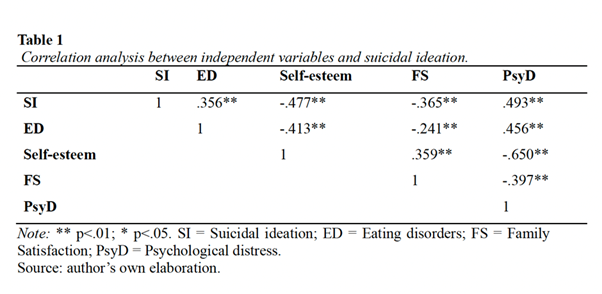
Tabla 1
Correlation analysis independent variables and suicidal ideation
Source: Author´s own elaboration.
3.2. Regression analysis
Before conducting the linear regression analysis, the important step to ensure the model's reliability was taken by checking for collinearity among the predictor variables.
To assess collinearity, two key indicators were used: Tolerance (TOL) and the Variance Inflation Factor (VIF), as suggested by Neter et al. (1990). They established that VIF values above or in the range of 1 to 5 indicate no collinearity or moderate collinearity, respectively. Additionally, TOL values between 0.1 and 1 were considered acceptable (López-Roque, 2022).
The theoretical model was then tested using a block-wise linear regression analysis, with the results presented in Table 2. As shown in the table, the first block included only sociodemographic variables, and among these, only sex emerged as a significant predictor of suicidal ideation in adolescents and young adults.
The equation in the second block included both the sociodemographic variables and all other predictive variables. In this model, the predictors of suicidal ideation are eating disorders, psychological distress, self-esteem, and family satisfaction. The results show that, when controlling for the other variables in the model, increases in eating disorders and psychological distress predict higher levels of suicidal ideation, while increases in self-esteem and family satisfaction predict lower levels of suicidal ideation. Overall, the model accounts for 32.1% of the observed variability, indicating that these predictive variables significantly contribute to explaining suicidal ideation among adolescents and young adults.
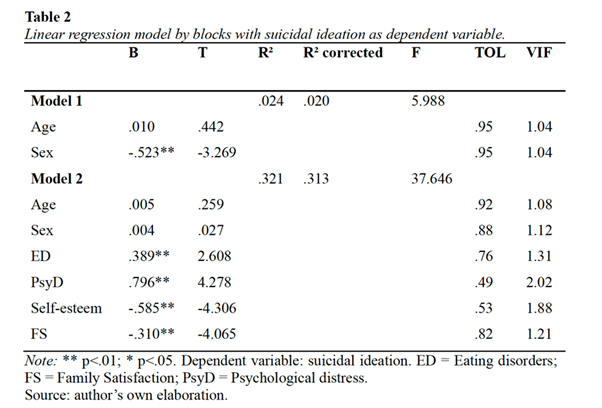
Tabla 2
Linear regression model by blocks with suicidal ideation as dependent variable
Source: Author´s own elaboration
3.3. Moderation analysis
Considering that age and sex can be significant factors in determining the behavior of certain risk variables, such as eating disorders, psychological distress and suicidal ideation, the decision was made to explore whether sex and age moderate the relationship between each independent variable and suicidal ideation. The effect of two potential protective factors on suicidal ideation was also analyzed: self-esteem and family satisfaction. To accomplish this, a moderation analysis was conducted using the PROCESS macro, 3.4 version, for SPSS (Hayes, 2018).
As shown in Table 3, each independent variable shows a direct effect on suicidal ideation, with increases associated with eating disorders and psychological distress, and decreases linked to the protective factors. However, sex alone does not have any effect on these variables, nor does it moderate the relation between the independent variables and suicidal ideation.
In contrast to sex, as shown in Table 4, age not only has a direct effect on eating disorders, self-esteem, and psychological distress, but it also moderates the relationship between eating disorders and self-esteem with suicidal ideation. More specifically, the conditional effects are significantly higher for eating disorders (∆R² = 0.028), while the interaction with self-esteem shows a smaller but still meaningful increase (∆R² = 0.007).
Moderation models explain 15,5% of the variance in the interaction with age and eating disorders and 23,9% in relation to self-esteem. To determine the age range that influences the relationship between eating disorders and self-esteem in relation to suicidal ideation, the pick-a-point technique was used. This technique provides three groups of values for the moderating variable: low, medium, and high age (16, 19, and 22,5 years), along with their corresponding coefficients on the effect.
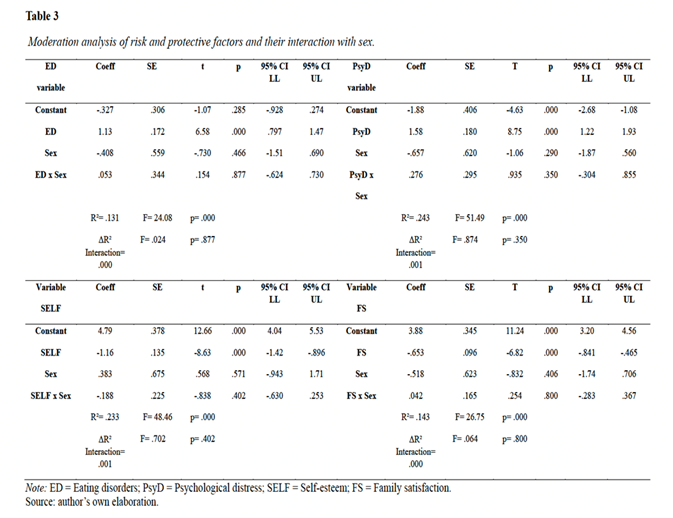
Tabla 3
Moderation analysis of risk and protective factor and their interaction with sex
Source: Author´s own elaboration
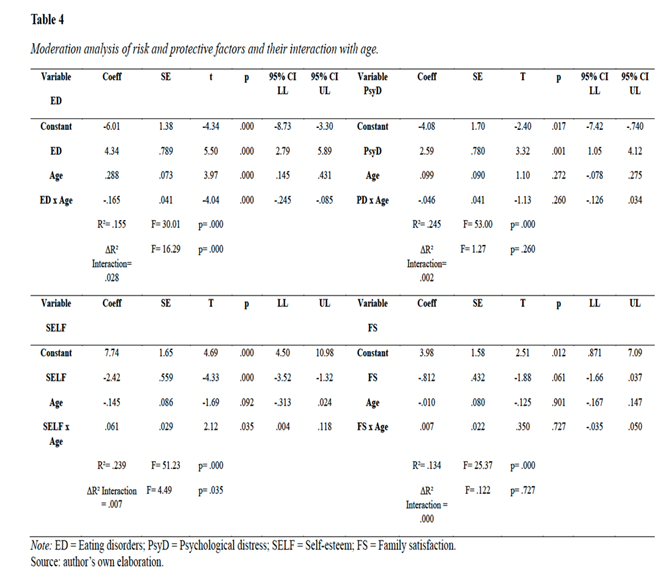
Tabla 4
Moderation analysis of risk and protective factors and their interaction with age
Source: Author´s own elaborationTable 5 illustrates the pick-a-point technique for the variables that showed significant values, where it is clear that the effects of age are statistically significant in all three age groups. However, the strongest effects are seen in the youngest age group, with their influence decreasing as age increases. In other words, while there is a significant conditional effect across all age ranges, these effects are most pronounced among younger individuals. Specifically, the negative impact of eating disorders on suicidal ideation is greater among younger people, while self-esteem proves to be more beneficial for this group as well.
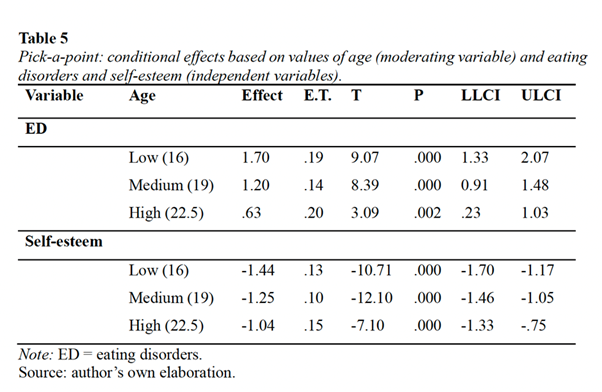
Tabla 5
Pick-a-point: conditional effects based on values of age (moderating variable) and eating dissorders and self-esteem (independent variables)
Source: Author´s own elaboration
To determine the age range where age has a conditional effect, the Johnson-Neyman technique was used. This method identifies the specific values at which the moderating variable (age) begins to exert its influence. For self-esteem, no specific age range was found where the conditional effect of age diminishes. In other words, all ages included in the study (16-29 years) benefit from the effects of self-esteem on suicidal ideation, although these effects decrease as individuals get older.
In the case of eating disorders, the Johnson-Neyman technique revealed a specific range where age no longer has an effect. It showed that from ages 16 to 23.52, age influences the relationship between eating disorders and suicidal ideation, with more pronounced negative effects for the younger individuals. Beyond 23.52 years, age ceases to have an impact.
4. Discussion
The results of this study support the majority of the proposed hypotheses and provide a deeper understanding of the psychological factors associated with suicidal ideation among adolescents and young adults.
First, the findings confirmed that eating disorders significantly increase the likelihood of suicidal ideation in adolescents and young adults (H1). This result aligns with previous literature, which has highlighted the strong association between eating disorders and suicidal thoughts in these populations (Amiri y Khan, 2023; Lipson & Sonneville, 2020; Perkins et al., 2021; Semenova et al., 2022; Smith et al., 2018; Varela-Besteiro et al., 2018; Wang et al., 2019).
Regarding the second hypothesis (H2), which proposed a significant link between psychological distress (anxiety and depression) and suicidal thoughts, the results confirm that mental health issues are key predictors of suicidal ideation in young people. This finding aligns with previous research that has identified anxiety and depression as crucial factors in the emergence of suicidal thoughts and behaviors (Cantor et al., 2023; Leigh et al., 2022; Meets et al., 2023; Sánchez-Merino et al., 2023; Xu et al., 2023). Moreover, the data indicate that children with severe symptoms of depression or anxiety are twice as likely to experience suicidal thoughts or attempt suicide during adolescence compared to those with milder symptoms (Orri et al., 2018).
The third and fourth hypotheses (H3 and H4), which proposed that self-esteem and family satisfaction act as protective factors against suicidal ideation were also confirmed. Results show that high self-esteem and positive family relations can significantly mitigate the risk of suicidal thoughts in adolescents and young adults. Interestingly, this positive effect of family satisfaction is an innovative finding, since this relation has not been explored in detail in previous literature. This finding suggests that family environments could play a crucial role in protecting against suicidal ideation, highlighting an important area for future research. These findings align with previous research highlighting the importance of high self-esteem (Cortaza-Ramírez et al., 2022; El-Masri & El-Monshed, 2021; Lara-Flores & Bonita-Basantes, 2022; Shagufta, 2022) and positive family environments (Aguilar-Sigueñas & Villarreal-Zegarra, 2022; Chiang et al., 2021; Harder et al., 2023; Wang, 2023) in the prevention of suicidal behaviors.
The fifth hypothesis (H5), which suggested that sex modulates the relations between psychological factors (EDs, psychological distress, self-esteem, family satisfaction) and suicidal ideation, was not confirmed by the results obtained. The analyses showed no direct effect or moderation relationship between these variables and suicidal ideation. This finding suggests that the impact of eating disorders, psychological distress, self-esteem and family satisfaction over suicidal ideation is consistent across both sexes. This aligns with previous research (Izquierdo et al., 2023; Pulido et al, 2022; Rainbow et al., 2021; Tan-Dat et al., 2023). However, other factors not considered in this study, such as cultural or socioeconomic differences, may influence how sex interacts with these factors, presenting an intriguing area for future research.
Finally, results confirmed the sixth hypothesis (H6), which proposed that age modulates the relations between the psychological factors mentioned above and suicidal ideation. Age showed a significant moderating effect in the relation between suicidal ideation, eating disorders and self-esteem. It was observed that the impact of eating disorders on suicidal ideation is higher in younger participants and decreases with age. This finding aligns with previous research suggesting that eating disorders primarily manifest during adolescence and young adulthood, although they can also occur in adulthood, but less frequently (Arrija-Val et al., 2022; Franco et al., 2019). However, current evidence is not definitive regarding whether the impact of eating disorders on suicidal thoughts is inherently greater in young people, highlighting the need for future research to explore this dynamic in more depth.
Similarly, self-esteem had a stronger protective effect against suicidal ideation in younger individuals, although this effect remained significant across all ages studied, aligning with previous research (Bakken et al., 2024).
5. Conclusion
This study offers a detailed insight into the factors associated with suicidal ideation among adolescents and young adults in Spain. The results obtained confirm that eating disorders, psychological distress (anxiety and depression), self-esteem and family satisfaction are relevant factors in the prevention of suicidal ideation in adolescents and young adults.
These findings have important implications for both intervention and future research. Practically, early detection and treatment of eating disorders, as well as promoting mental health and strengthening self-esteem and family relationships, are crucial for reducing the risk of suicidal ideation. It is recommended to implement regular screening programs in educational settings, conduct workshops on body image and healthy eating, and ensure accessible psychological support services for young people. Additionally, the importance of developing personal development programs that promote healthy self-esteem and strengthen family relationships through family therapy and other support resources is emphasized.
From a research perspective, it is essential to keep exploring how the interactions between these factors influence suicidal ideation. A more detailed identification and analysis of the underlying mechanisms of these relationships could improve our understanding of the processes leading to suicidal thoughts and help design more targeted prevention strategies.
The study shows that age has a significant moderating effect in the relation between certain psychological factors and suicidal ideation. This finding highlights the need for future research to examine how variations in developmental stages affect the relationship between risk factors and suicidal ideation. Additionally, while sex did not emerge as a significant moderator in this study, it remains important to investigate how individual context and gender differences may influence suicidal thoughts.
The analysis of the relation between family satisfaction and suicidal ideation in adolescents and young adults is also an innovative aspect of the study. Although previous literature has highlighted the importance of family environments, specific research on this link is still limited. This study provides new information and highlights the need to continue investigating how different dimensions of family satisfaction can impact suicidal ideation.
The study also presents some limitations, such as its cross-sectional design, which does not allow for the establishment of causal relations between the variables analysed. Additionally, the sample is limited to two provinces in Spain, which may restrict the application of the results to other populations and cultural contexts. Future research could address these limitations though longitudinal designs and broader samples.
In conclusion, the study highlights the complexity of the interaction of psychological factors and suicidal ideation in adolescents and young adults. The findings provide a solid ground for future research to explore in detail the mechanisms in these relations and contextual adaptations, contributing to a deeper understanding and formulation of prevention strategies based on evidence.
6. Data availability statement
The dataset generated and analyzed during the current study is available in the Open Science Framework (OSF) repository:
https://osf.io/g9fsa/?view_only=2cf52a74bbb345e2bfcabdf86fc57fe8
7. Funding
This study was funded by: PID2023-147438OB-I00. Ministerio de Ciencia, Innovación y Universidades. Convocatoria Generación de Conocimiento 2023.
B3-2023/33. Vicerrectorado de Investigación y Transferencia. II Plan Propio de Investigación, Transferencia y Divulgación Científica de la Universidad de Málaga. PPRO-HUM590-G-2023 (HUM590-G-FEDER).
8. Author contributions
Conceptualización (AAMA, GM y LGJ); Curación de datos (AAMA, GM y LGJ); Análisis formal (AAMA, GM y LGJ); Adquisición de fondos (AAMA, GM y LGJ); Investigación (AAMA, GM y LGJ); Metodología (AAMA, GM y LGJ); Administración del proyecto (AAMA, GM y LGJ); Recursos (AAMA, GM y LGJ); Software (MITG, NLRM y JACM); Supervisión (AAMA, GM y LGJ); Validación (AAMA, GM y LGJ); Visualización (AAMA, GM y LGJ); Redacción como borrador inicial (AAMA, GM y LGJ); Redacción como revisión y edición (AAMA, GM y LGJ). Los porcentajes de las contribuciones son AAMA (34%), GM (33%) y LGJ (33%). Todos los autores leyeron y aprobaron el manuscrito final.
Acknowledgments
PID2023-147438OB-I00. Ministerio de Ciencia, Innovación y Universidades. Convocatoria Generación de Conocimiento 2023.
B3-2023/33. Vicerrectorado de Investigación y Transferencia. II Plan Propio de Investigación, Transferencia y Divulgación Científica de la Universidad de Málaga. PPRO-HUM590-G-2023 (HUM590-G-FEDER).
9. References
Aguilar-Sigueñas, L. & Villarreal-Zegarra, D. (2022). An explanatory model of suicidal ideation based on family functionality and mental health problems: A cross-sectional study of medical students. Interacciones, e260. https://doi.org/10.24016/2022.v8.260
Alves da Silva, H., Aurélio, C., Fonseca, R., Silva, G. & Barros, O. (2023). Predisposing factors for the incidence of suicide in young people. Health and Society, 3(02), 681-700. https://doi.org/10.51249/hs.v3i02.1311
American Psychiatric Association. (2013). Diagnostic and Statistical Manual of Mental Disorders (5ª ed.). American Psychiatric Publishing.
Amiri, S. & Khan, M. A. (2023). Prevalence of non-suicidal self-injury, suicidal ideation, suicide attempts, suicide mortality in eating disorders: a systematic review and meta-analysis. Eating Disorders, 31(5), 487–525. https://doi.org/10.1080/10640266.2023.2196492
Arrija-Val, V., Santi-Cano, M. J., Novalbos-Ruiz, J. P., Canals, J. y Rodríguez-Martín, A. (2022). Caracterización, epidemiología y tendencias de los trastornos de la conducta alimentaria. Nutrición hospitalaria, 39, 8-15. https://dx.doi.org/10.20960/nh.04173
Arsandaux, J., Galéra, C. & Salamon, R. (2020). The association of self‐esteem and psychosocial outcomes in young adults: a 10‐year prospective study. Child and Adolescent Mental Health, 26(2), 106-113. Portico. https://doi.org/10.1111/camh.12392
Atienza, F. L., Moreno, Y. y Balaguer, I. (2000). Análisis de la dimensionalidad de la Escala de Autoestima de Rosenberg en una muestra de adolescentes valencianos. Revista de Psicología Universitas Tarraconensis, 22, 29-42.
Bados, A., Solanas, A. & Andrés, R. (2005). Psychometric properties of the Spanish version of Depression, Anxiety and Stress Scales (DASS). Psicothema, 17(4), 679–683.
Bakken, V., Lydersen, S., Skokauskas, N., Sund, A. M. & Kaasbøll, J. (2024). Protective factors for suicidal ideation: a prospective study from adolescence to adulthood. European Child & Adolescent Psychiatry.https://doi.org/10.1007/s00787-024-02379-w
Ballesteros, J. C. (2023). Salud y bienestar juvenil en España. Un análisis longitudinal 2017-2021. Zenodo. https://doi.org/10.5281/zenodo.7859358
Baños-Chaparro, J. (2024). Análisis de Red de la Ideación Suicida Pasiva y Activa en Adolescentes. Revista de Psicología Clínica Con Niños y Adolescentes, 11(1). https://doi.org/10.21134/rpcna.2024.11.1.8
Barroso, A. (2019). Comprender el suicidio desde una perspectiva de género: una revisión crítica bibliográfica. Revista de la Asociación Española de Neuropsiquiatría, 39(135), 51-66. https://dx.doi.org/10.4321/s0211-57352019000100004
Bermúdez, L. V., Chacón, M. A. y Rojas, D. M. (2021). Actualización en trastornos de conducta alimentaria: anorexia y bulimia nerviosa. Revista Médica Sinergia, 6(8), e694. https://doi.org/10.31434/rms.v6i8.694
Bilsen J. (2018). Suicide and Youth: Risk Factors. Frontiers in psychiatry, 9, 540. https://doi.org/10.3389/fpsyt.2018.00540
Bulycheva, E. V. (2023). Adolescents’ relationships with the social environment as a factor of protection against risky behaviours. National Psychological Journal, 49(1), 88-101. https://doi.org/10.11621/npj.2023.0108
Cantor, N., Kingsbury, M., Warner, E., Landry, H., Clayborne, Z., Islam, R. & Colman, I. (2023). Young adult outcomes associated with adolescent suicidality: A meta-analysis. Pediatrics, 151(3). https://doi.org/10.1542/peds.2022-058113
Cañón, S. C. & Carmona, J. A. (2018). Ideación y conductas suicidas en adolescentes y jóvenes. Pediatría Atención Primaria, 20(80), 387-397.
Cenkseven-Önder, F. (2018). Social Support and Coping Styles in Predicting Suicide Probability among Turkish Adolescents. Universal Journal of Educational Research, 6(1), 145-154.https://doi.org/10.13189/ujer.2018.060114
Chen, X. & Ma, R. (2023). Adolescents’ Self-Esteem: The Influence Factors and Solutions. Journal of Education, Humanities and Social Sciences, 8, 1562–1566. https://doi.org/10.54097/ehss.v8i.4520
Chiang, Y., Lin, Y., Li, X., Lee, C., Zhang, S., Lee, T., Chang, H., Wu, C., & Yang, H. (2021). Parents’ right strategy on preventing youngsters’ recent suicidal ideation: a 13-year prospective cohort study. Journal of Mental Health, 31(3), 374-382. https://doi.org/10.1080/09638237.2021.1979490
Cortaza Ramírez, L., Aguilar Hernández, H. khiabet, Montiel Santiago, R. B., & Morales Rodríguez, Z. Y. (2022). Autoestima e ideación suicida en adolescentes estudiantes de secundaria. LATAM Revista Latinoamericana de Ciencias Sociales y Humanidades, 3(2), 286–296. https://doi.org/10.56712/latam.v3i2.82
Cudris-Torres, L. (2023). Family functioning and self-harm behaviors in adolescents and young people in the municipality of Valledupar-Colombia. Gaceta Médica de Caracas, 131(3). https://doi.org/10.47307/gmc.2023.131.s3.13
Dat, N., Mitsui, N., Asakura, S., Takanobu, K., Fujii, Y., Toyoshima, K., Kako, Y. & Kusumi, I. (2022). The Effectiveness of Self-Esteem-Related Interventions in Reducing Suicidal Behaviors: A Systematic Review and Meta-Analysis. Frontiers in Psychiatry, 13. https://doi.org/10.3389/fpsyt.2022.925423
Derogatis, L. R. & Lazarus, L. (1994). SCL-90—R, Brief Symptom Inventory, and matching clinical rating scales. In M. E. Maruish (Ed.), The use of psychological testing for treatment planning and outcome assessment (pp. 217–248). Lawrence Erlbaum Associates, Inc.
Domínguez, D., Hermosillo, A. y Vacío, M. A. (2016). Efecto de los factores de protección y de riesgo sobre el comportamiento suicida en estudiantes de Psicología. Investigación y Ciencia de La Universidad Autónoma de Aguascalientes, 69, 73-80. https://doi.org/10.33064/iycuaa2016691873
Duriez, P., Goueslard, K., Treasure, J., Quantin, C. & Jollant, F. (2023). Risk of non‐fatal self‐harm and premature mortality in the three years following hospitalization in adolescents and young adults with an eating disorder: A nationwide population‐based study. International Journal of Eating Disorders, 56(8), 1534-1543. https://doi.org/10.1002/eat.23974
El-Masri, Y. & El-Monshed, A. (2021). The Relationship between Self-Compassion, Self-Esteem and Suicidal Ideation among a Cohort of University Students. Evidence-Based Nursing Research, 3(1), 12. https://doi.org/10.47104/ebnrojs3.v3i1.187
Fitzpatrick, S., Brew, B., Handley, T., & Perkins, D. (2022). Men, suicide, and family and interpersonal violence: A mixed methods exploratory study. Sociology of Health and Illness, 44(6), 991-1008. https://doi.org/10.1111/1467-9566.13476
Fonseca-Pedrero, E. y Diez, A. (2018). Conducta suicida y juventud: pautas de prevención para familias y centros educativos. Revista de Estudios de Juventud, 120, 35-46.
Fonseca-Pedrero, E., Inchausti, F., Pérez, L., Aritio, A., Ortuño-Sierra, J., Sánchez-García, A., Lucas-Molina, B., Domínguez, C., Foncea, D., Espinosa, V., Gorría, A., Urbiola-Merina, E., Fernández, M., Merina, C., Gutiérrez, C., Aures, M., Campos, M., Domínguez-Garrido, E. y Pérez de Albéniz, A. (2018). Ideación suicida en una muestra representativa de adolescentes españoles. Revista de Psiquiatría y Salud Mental, 11(2), 76-85. https://doi.org/10.1016/j.rpsm.2017.07.004
Franco, K., Díaz, F. y Bautista, M. (2019). Estatus de peso, conductas alimentarias de riesgo e insatisfacción corporal en mujeres adolescentes y jóvenes. Archivos de Medicina (Manizales), 19(2). https://doi.org/10.30554/archmed.19.2.3283.2019
García-Puertas, D. (2020). Influencia del uso de Instagram sobre la conducta alimentaria y trastornos emocionales. Revisión sistemática. Revista Española de Comunicación en Salud, 11(2), 244-254. https://doi.org/10.20318/recs.2020/5223
González, A. y Miguel, M. D. (2023). Redes sociales ¿factor determinante en el desarrollo de trastornos alimentarios en adolescentes y jóvenes adultos/as? Enfermería integral: Revista científica del Colegio Oficial de Enfermería de Valencia, (136), 72-80.
Gvion, Y. & Apter, A. (2012). Suicide and suicidal behavior. Public health reviews, 34, 1-20.
Harder, V., Lor, J., Omland, L. & Rettew, D. (2023). Protective Associations between Supportive Environment and Suicidality among Minority and Majority Adolescents. Archives of Suicide Research, 28(2), 629-643. https://doi.org/10.1080/13811118.2023.2199808
Hayes, A. F. (2018). Introduction to Mediation, Moderation, and Conditional Process Analysis: A Regression-Based Approach (2nd ed.). The Guilford Press.
Hepper, E. (2023). Self-esteem. En Kristin J. August, Nicole M. Cain, Meghan M. Gillen, Jill M. Hooley, Kelly L. Klump, Wenhua Lu, Mindy Mechanic, Ronald E. Riggio Encyclopedia of Mental Health (Third Edition) (pp.125-139) Howard S. Friedman and Charlotte H. Markey https://doi.org/10.1016/B978-0-323-91497-0.00185-5
Instituto Nacional de Estadística (2021, 10 de noviembre). Defunciones según la causa de muerte. Año 2020. https://www.ine.es/prensa/edcm_2020.pdf
Izquierdo, A. M., Nelson, J. D., Daza, A., Gasbarro, A., Hardin, R., Marino, J. & Fischer, S. (2023). Predictors of current suicidal ideation in a multi-diagnostic sample of individuals with eating disorders. Journal of Eating Disorders, 11(1). https://doi.org/10.1186/s40337-023-00789-w
Junus, A. & Yip, P. (2023). Preventing comorbidity between distress and suicidality: a network analysis. Npj Mental Health Research, 2(1). https://doi.org/10.1038/s44184-023-00022-1
Kaloğlu, H. & Hocaoglu, C. (2023). Suicidal Behavior in Eating Disorders. Psikiyatride Güncel Yaklaşımlar, 15(4), 687-696. https://doi.org/10.18863/pgy.1224756
Karayazi, H. (2023). Suicide in adolescents: A case study. Journal of Awareness, 8(2), 185-194. https://doi.org/10.26809/joa.2018
Kareem, A. (2023). Family Support as Predictor of life Satisfaction and Happiness in Pakistani Adolescents. Journal of Development and Social Sciences, 4(2). https://doi.org/10.47205/jdss.2023(4-ii)48
Kessler, R. & Mroczek, D. (1994). Final Versions of our Non-Specific Psychological Distress Scale. Ann Arbor, MI: Survey Research Center of the Institute for Social Research, University of Michigan.
Kirkpatrick, R., Breton, E., Biorac, A., Munoz, D. & Booij, L. (2023). Non‐suicidal self‐injury among individuals with an eating disorder: A systematic review and prevalence meta‐analysis. International Journal of Eating Disorders, 57(2), 223-248. https://doi.org/10.1002/eat.24088
Lara-Flores, M, y Bonilla-Basantes, P. (2022). Autoestima y su relación con la ideación suicida en estudiantes universitarios. Ciencia Latina Revista Científica Multidisciplinar, 6(6), 10114-10130. https://doi.org/10.37811/cl_rcm.v6i6.4120
Leigh, E., Chiu, K. & Ballard, E. (2022). Social Anxiety and Suicidality in Youth: A Systematic Review and Meta-analysis. Research on Child and Adolescent Psychopathology, 51(4), 441–454. https://doi.org/10.1007/s10802-022-00996-0
Lipson, S. & Sonneville, K. (2020). Understanding suicide risk and eating disorders in college student populations: Results from a National Study. International journal of eating disorders, 53(2), 229-238.
Liu, X., Liu, M., Li, H., Mo, L. & Liu, X. (2022). Transition from Depression to Suicidal Attempt in Young Adults: The Mediation Effect of Self-Esteem and Interpersonal Needs. International Journal of Environmental Research and Public Health, 19(21), 14342. https://doi.org/10.3390/ijerph192114342
López-Roque, J. (2022). Técnicas de selección de variables en regresión lineal múltiple. [Trabajo fin de Máster]. Universidad de Huelva y Universidad Internacional de Andalucía. https://dspace.unia.es/handle/10334/6557
Marrero, R. J., Bello, M., Morales-Marrero, D. & Fumero, A. (2023). Emotion Regulation Difficulties, Family Functioning, and Well-Being Involved in Non-Suicidal Self-Injury and Suicidal Risk in Adolescents and Young People with Borderline Personality Traits. Children, 10(6), 1057. https://doi.org/10.3390/children10061057
Metts, A., Echiverri‐Cohen, A., Yarrington, J., Zinbarg, R., Mineka, S. & Craske, M. (2023). Longitudinal associations among dimensional symptoms of depression and anxiety and first onset suicidal ideation in adolescents. Suicide and Life-Threatening Behavior, 53(3), 457–469. https://doi.org/10.1111/sltb.12956
Mihić, J., Skinner, M., Novak, M., Ferić, M. & Kranželić, V. (2022). The importance of family and school protective factors in preventing the risk behaviors of youth. International Journal of Environmental Research and Public Health, 19(3), 1630. https://doi.org/10.3390/ijerph19031630
Moller, C. I., Davey, C. G., Badcock, P. B., Wrobel, A. L., Cao, A., Murrihy, S., Sharmin, S. & Cotton, S. M. (2022). Correlates of suicidality in young people with depressive disorders: A systematic review. Australian & New Zealand Journal of Psychiatry, 56(8), 910–948. https://doi.org/10.1177/00048674221086498
Montes de Oca Valdez, L. y Rodríguez-Medina, D. A. (2019). Factores de riesgo y protección del suicidio en adultos mayores. Psicología y Salud, 29(2), 187–194. https://doi.org/10.25009/pys.v29i2.2585
Mosqueda-Díaz, A., González-Carvajal, J., Dahrbacun-Solis, N., Jofré-Montoya, P., Caro-Castro, A., Campusano-Coloma, E. y Escobar-Ríos, M. (2019). Malestar psicológico en estudiantes universitarios: una mirada desde el modelo de promoción de la salud. SANUS Revista De Enfermería, 1(1), 48-57. https://doi.org/10.36789/sanus.vi1.58
Nardone, G., Giannotti, E. y Rocchi, R. (2013). Modelos de familia: conocer y resolver los problemas entre padres e hijos. Herder Editorial.
Neter, J., Wasserman, W. & Kutner, M. H. (1990), Applied linear statistical models: regression, analysis of variance, and experimental designs, (3ªed). Robert Irwin, Homewood. https://search.worldcat.org/es/search?q=bn:025608338X
Olson, D., Stewart, K. & Wilson, L. (1990). Health and stress profile (HSP), revised. Minneapolis: Profile of Health Systems.
Orri, M., Galera, C., Turecki, G., Forte, A., Renaud, J., Boivin, M., Tremblay, R., Côté, S. M. & Geoffroy, M. (2018). Association of Childhood Irritability and Depressive/Anxious Mood Profiles With Adolescent Suicidal Ideation and Attempts. JAMA Psychiatry, 75(5), 465-473. https://doi.org/10.1001/jamapsychiatry.2018.0174
Ortiz-Sánchez, F., Brambila-Tapia, A., Cárdenas-Fujita, L., Toledo-Lozano, C., Samudio-Cruz, M., Gómez-Díaz, B., García, S., Rodríguez-Arellano, M., Zamora-González, E. & López-Hernández, L. (2023). Family Functioning and Suicide Attempts in Mexican Adolescents. Behavioral Sciences, 13(2), 120. https://doi.org/10.3390/bs13020120
Park, E. (2023). The influences of mental health problem on suicide-related behaviors among adolescents: Based on Korean Youth Health Behavior Survey. The Journal of Korean Academic Society of Nursing Education, 29(1), 98-108. https://doi.org/10.5977/jkasne.2023.29.1.98
Paykel, E., Myers, J., Lindenthal, J. & Tanner, J. (1974). Suicidal Feelings in the General Population: A Prevalence Study. British Journal of Psychiatry, 124(582), 460-469. https://doi.org/10.1192/bjp.124.5.460
Perkins, N., Ortiz, S., Smith, A. & Brausch, A. (2021). Suicidal Ideation and Eating Disorder Symptoms in Adolescents: The Role of Interoceptive Deficits. Behavior Therapy, 52(5), 1093-1104. https://doi.org/10.1016/j.beth.2021.03.005
Pulido, E. G., Lora, L. J. y Coronel, L. V. (2022). Evaluación de un modelo explicativo del riesgo suicida con base en factores familiares. Interdisciplinaria. Revista de Psicología y Ciencias Afines, 39(2). https://doi.org/10.16888/interd.2022.39.2.19
Quezada, J., Zavala, E. y Lenti, M. (2015). Satisfacción familiar en mujeres jóvenes. Avances En Psicología, 23(2), 223-229. https://doi.org/10.33539/avpsicol.2015.v23n2.164
Quintana, J., Padierna, A., Esteban, C., Arostegui, I., Bilbao, A. & Ruiz, I. (2003). Evaluation of the psychometric characteristics of the Spanish version of the Hospital Anxiety and Depression Scale. Acta Psychiatrica Scandinavica, 107(3), 216-221. https://doi.org/10.1034/j.1600-0447.2003.00062.x
Rainbow, C., Baldwin, P., Hosking, W., Gill, P., Blashki, G. & Shand, F. (2021). Psychological Distress and Suicidal Ideation in Australian Online Help-Seekers: The Mediating Role of Perceived Burdensomeness. Archives of Suicide Research, 27(2), 439–452. https://doi.org/10.1080/13811118.2021.2020191.
Rimes, K., Smith, P. & Bridge, L. (2023). Low self-esteem: a refined cognitive behavioural model. Behavioural and Cognitive Psychotherapy, 51(6), 579-594. https://doi.org/10.1017/s1352465823000048
Rodas, A., Deutschmann, A., Nij, S., Castellanos, O., Domínguez, G. y Morales, A. (2021). Prevalencia de síntomas de depresión, ansiedad e ideación suicida en estudiantes de medicina universitarios. Revista Médica (Colegio de Médicos y Cirujanos de Guatemala), 160(1), 11–17. https://doi.org/10.36109/rmg.v160i1.305
Rosenberg, M. (1965). La autoimagen del adolescente y la sociedad. Paidós.
Sánchez-Merino, E., Martínez-Vispo, C. & González Sanguino, C. (2023). A cross-sectional study of suicidal ideation and behaviour, depression, anxiety and stress in a Spanish sample. Mental health in young people after the Covid-19 pandemic. Mortality, 1–13. https://doi.org/10.1080/13576275.2023.2203805
Sanmartín, A., Ballesteros, J. C., Calderón, D. y Kuric, S. (2022). Barómetro Juvenil 2021. Salud y bienestar: Informe Sintético de Resultados. Madrid: Centro Reina Sofía sobre Adolescencia y Juventud, Fundación FAD Juventud. https://doi.org/10.5281/zenodo.6340841
Semenova, N., Slobodskaya, H. & Rezun, E. (2022). Suicidal Behavior in Adolescent Girls with Eating Disorders. European Psychiatry, 65(1), 383–S383. https://doi.org/10.1192/j.eurpsy.2022.972
Serrano-Ruiz, C. y Olave-Chaves, J. (2017). Factores de riesgo asociados con la aparición de conductas suicidas en adolescentes. MedUNAB, 20(2), 139-147. https://doi.org/10.29375/01237047.2272
Shagufta, S. (2022). Self-esteem and Suicidal Ideation in Undergraduate Students. Psychologia, 16(1), 13-21. https://doi.org/10.21500/19002386.5423
Smith, A., Zuromski, K. & Dodd, D. (2018). Eating disorders and suicidality: what we know, what we don’t know, and suggestions for future research. Current Opinion in Psychology, 22, 63-67. https://doi.org/10.1016/j.copsyc.2017.08.023
Tan-Dat, N., Mitsui, N., Asakura, S., Fujii, Y., Toyoshima, K. & Kusumi, I. (2023). Relationship between self-esteem and suicidal ideation before and during COVID-19 in a non-clinical sample: mediating effects of psychological distress and hopelessness. Frontiers in Psychiatry, 14. https://doi.org/10.3389/fpsyt.2023.1240715
Unikel-Santoncini, C., Bojórquez-Chapela, I. & Carreño-García, S. (2004). Validación de un cuestionario breve para medir conductas alimentarias de riesgo. Salud Pública de México, 46(6), 509–515. https://doi.org/10.1590/s0036-36342004000600005
Urdiales-Claros, R. y Sánchez-Álvarez, N. (2021). Sintomatología depresiva e ideación suicida como consecuencia de la pandemia de COVID-19. Escritos de Psicología, 14(2), 134-144. https://doi.org/10.24310/espsiescpsi.v14i2.12901
Varela-Besteiro, O., Serrano-Troncoso, E., Rodriguez-Vicente, V., Curet-Santisteban, M., Conangla-Rosello, G., Cecilia-Costa, R., Carulla-Roig, M., Matali-Costa, J. & Dolz-Abadia, M. (2017). Suicidal ideation and self-injurious behavior in adolescents with eating disorders. Actas españolas de psiquiatría, 45(4), 157-166.
Wang, S., Mancuso, C., Jo, J., Keshishian, A., Becker, K., Plessow, F., Izquierdo, A., Slattery, M., Franko, D., Misra, M., Lawson, E., Thomas, J. & Eddy, K. (2019). Restrictive eating, but not binge eating or purging, predicts suicidal ideation in adolescents and young adults with low‐weight eating disorders. International Journal of Eating Disorders, 53(3), 472-477. https://doi.org/10.1002/eat.23210
Wang, Z. (2023). Review on Data Mining and Data Analysis Method for Adolescent Suicide Problem. Highlights in Science, Engineering and Technology, 39, 1164–1169. https://doi.org/10.54097/hset.v39i.6724
World Health Organization. (2022, June 16). World mental health report: Transforming mental health for all. https://www.who.int/publications/i/item/9789240049338
Xu, S., Ju, Y., Wei, X., Ou, W., Ma, M., Lv, G., Zhao, X., Qin, Y., Li, Y., Li, L., Huang, M., Yang, S., Lu, Y., Chen, Y., Liu, J., Liu, J., Liu, B. & Zhang, Y. (2023). Network analysis of suicide ideation and depressive-anxiety symptoms among adolescents. Research Square.https://doi.org/10.21203/rs.3.rs-2643412/v1
Yang, Q., Hu, Y., Zeng, Z, Liu, S, Wu, T. & Zhang, G. (2022). The Relationship of Family Functioning and Suicidal Ideation among Adolescents: The Mediating Role of Defeat and the Moderating Role of Meaning in Life. International Journal of Environmental Research and Public Health, 19(23), 15895. https://doi.org/10.3390/ijerph192315895
Zhu, S., Li, X., & Wong, P. W. C. (2023). Risk and protective factors in suicidal behaviour among young people in Hong Kong: A comparison study between children and adolescents. Psychiatry Research, 321, 115059. https://doi.org/10.1016/j.psychres.2023.115059
Zigmond, A. & Snaith, R. (1983). The Hospital Anxiety and Depression Scale. Acta de Psiquiatría Escandinava, 67, 361-370.
Información adicional
redalyc-journal-id: 6721